Canon in Drag imagines a fictional Western art canon that evolved outside of the patriarchy. It includes a series of paintings in the style of iconic works, subverted through gender flipping and altered narratives, that are described in the voice of fictional art historians. These form the basis of a museum style exhibition, accompanied by an exhibition catalog in the vein of an art history survey book.

Installation view, Slag Gallery, NY
-
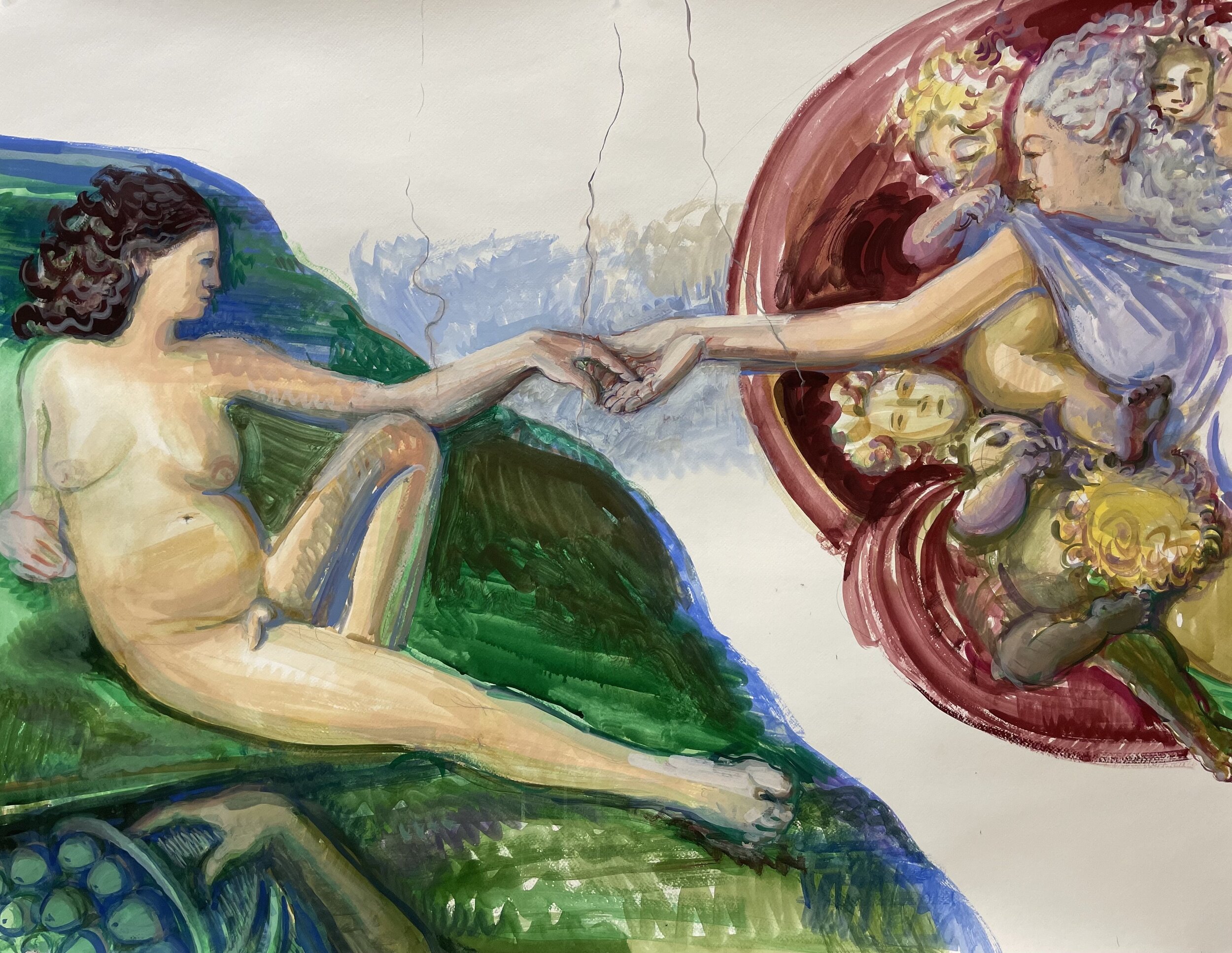
This original detail was revealed during the controversial restoration of the Sistine Chapel frescoes, which began in 1980. In contrast to the familiar version in which God keeps Adam at hands’ length, here the act of creation and touch are inextricably linked. Scholars have discovered that the contours of the divine hand correspond precisely with the female internal sexual anatomy, and that the human finger is pressing the g-spot. A personal journal of a nun from the time recounts covert premarital rites that took place in the chapel, with spiritual guides using this image to instruct young brides and grooms in the art of love making. It is no secret that Michelangelo’s relationship with the Catholic Church was strained. The Pope likely demanded that Michelangelo change the image to portray the narrative in the second chapter of Genesis in which Woman is created from the ribs of Man; however, this original work was retrieved and preserved by a group of acolytes who, like the painter himself, worshipped the God of whom it is written, "Male and Female They created Them" (Genesis 1:27).

-
This 1434 oil painting on oak panel commissioned by the Flemish merchant Mrs. Arnolfini to commemorate the orgasmic birth of her daughter is considered one of the most original and complex paintings in Western art. Its beauty, iconography, geometric orthogonal perspective, and expansion of the pictorial space with the use of a mirror is all quite remarkable. It is among the oldest panel paintings to have been executed in oils rather than in tempera. The painting was bought by the National Gallery in London in 1842.
While it is not explicitly a religious painting, the subject marks a departure from the Church’s taboo regarding the study of anatomy, and it demonstrates a desire to explore and celebrate the physiological origins of life. The image draws an explicit connection between power, pleasure, and the act of creation.
Notably, 1434 was also the year Jan van Eyck completed his lesser-known Portrait of G. Arnolfini and his Wife, commissioned by Mrs. Arnolfini’s husband.
-
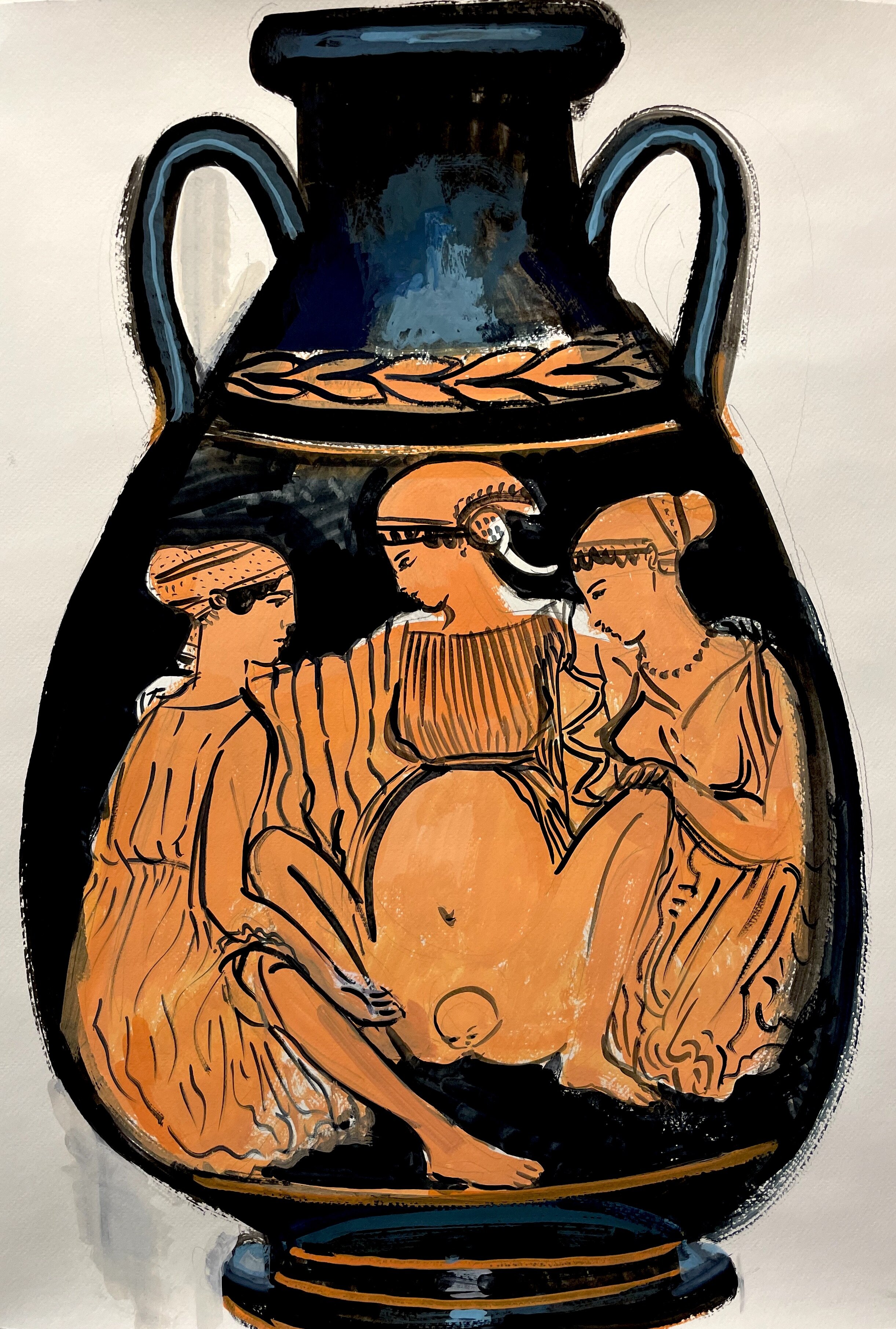
This ceramic vase was traced to the home of a noblewoman in ancient Greece circa 500 BCE and was likely commissioned to commemorate an orgasmic birth. This and similar vases were later traded by 15th century Flemish merchants and brought to Flanders, where they were highly valued for their aesthetic and spiritual qualities and often displayed in birthing rooms to inspire women during birth. Scholars suggest that the Flemish Master of The Orgasmic Birth of Mrs. Arnolfini (see 18) was likely inspired by the composition of this vase.

-
This depiction of the miracle of the menstruating martyr is of Flemish origin. The right panel depicts a crucifixion scene; the martyr’s blood is visible on her hands, feet, and brow, and the miraculous post-crucifixion menstrual blood trickles down her leg. The impression of blood is amplified by the brilliant red cloth of honor draped behind her. The left panel shows a swooning male figure supported by a companion, with both dressed in pale folded robes. The lily and skull on the ground highlight the symbolic cyclicality of life and death.
-
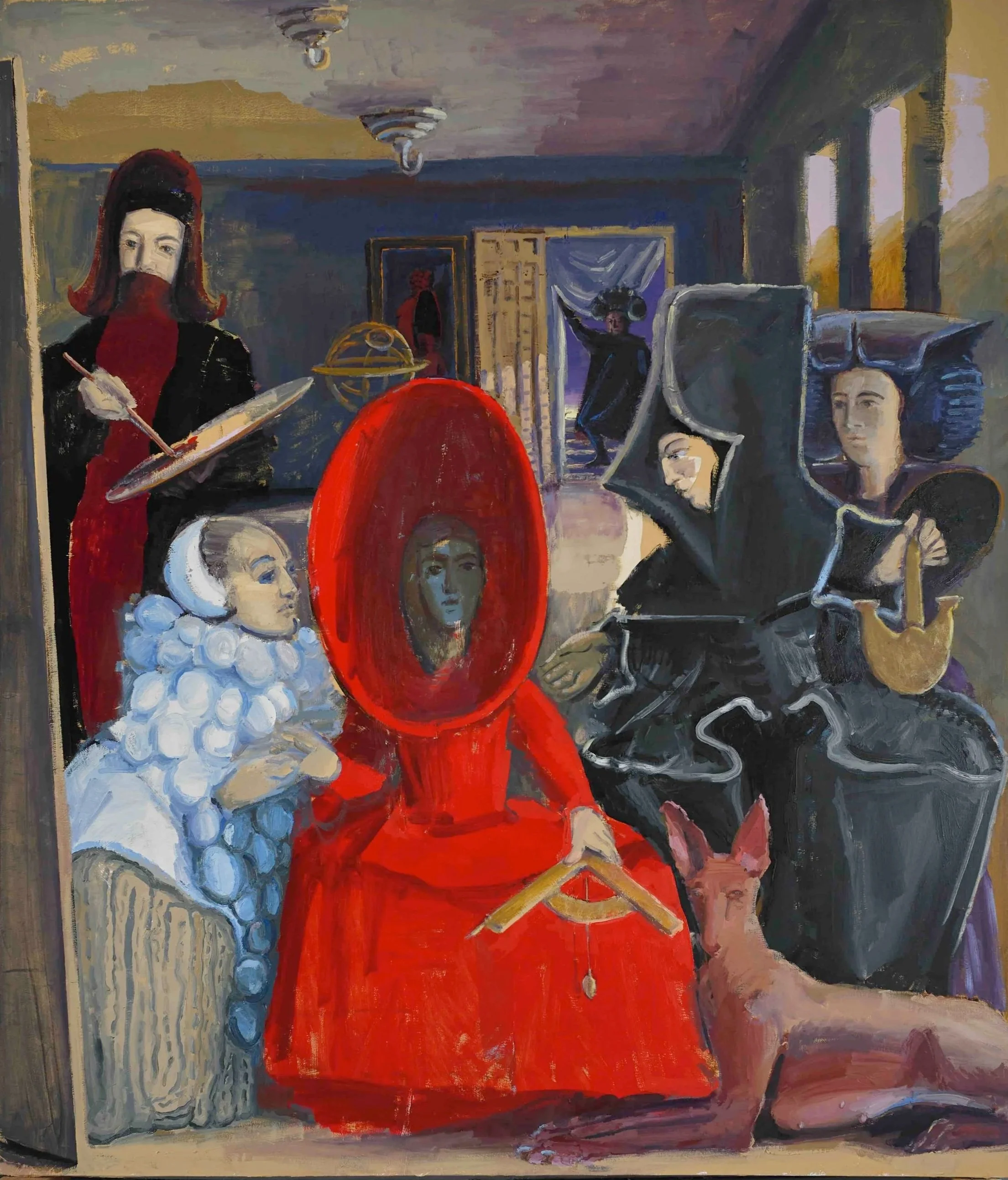
La Menarquia is set in the artist’s studio inside Philippa IV’s palace in 17th century Madrid. In the center foreground stands her daughter, the 12-year-old Infanta Margaret Teresa, moments before her royal Menarche ceremony, the much anticipated initiation rite marking her first blood. She wears a scarlet dress, a dramatic symbol of her blood power. Her partially concealed gaze reflects the upcoming transition from light to dark –from primal to higher consciousness – that is to unfold in the ceremony.
The three attendants wear ceremonial garbs that express key ritual elements and emphasize the inherent connection, marked by the ritual, between internal physiology and external celestial cycles. The figure to the left adorns the Moon Cap, the Bulbous Tunic, and the Intestinal Skirt. To the right, one figure wears the skeletal Pelvis Shirt, and the other flaunts the Janus Headdress, recalling the Roman god of gateways, doorways, beginnings and endings, past and future, and the duality of the masculine and feminine. They hold scientific tools of the day symbolizing the interplay between menstrual and scientific knowledge. On the back wall, a mirror reflects a life size sculpture of a menstruant, no doubt a treasured heirloom. A dark figure, also adorned with a Janus Headdress, holds the curtain to the dawn-lit ceremony.
-
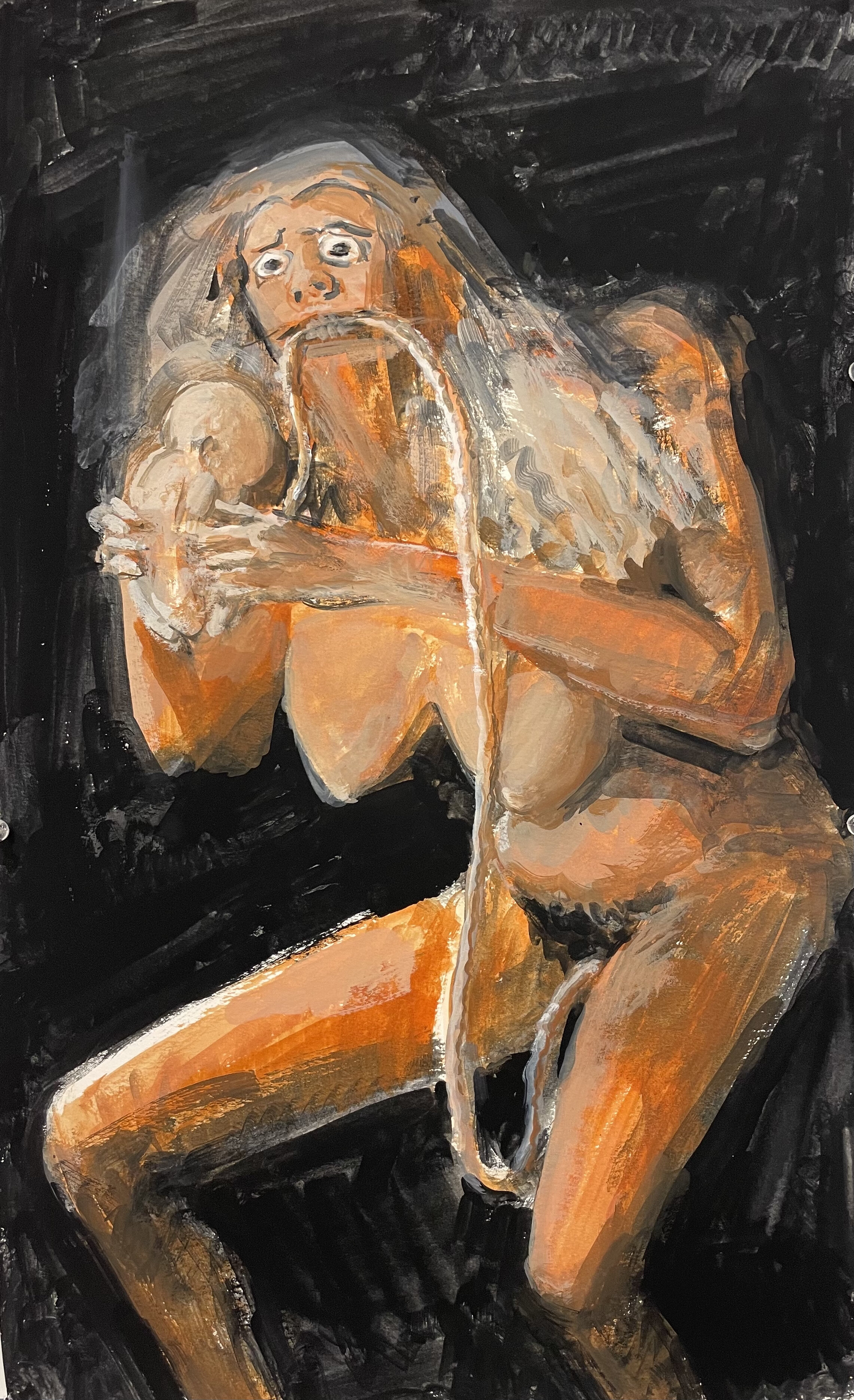
Unlike Goya’s painting from the same period of Saturn Devouring His Sons, the fierce gesture in this image results in separation, a necessary step in the survival of both baby and mother. Modern scholars applaud the artist’s pioneering exploration of the darker sides of motherhood, some interpreting the image as a metaphor for the often unspoken topic of postpartum rage.

-
An unflinching portrait of a highly intelligent, shrewd, and aging man who has achieved great status despite his gender. The oil painting is a portrait of the pope, born Giovanni Battista Pamphili, who was the head of the Catholic Church and ruler of the Papal States from 1644 to his death in 1655. He is dressed in linen vestments that emulate 17th century monarchical menstruants’ ritual robes. A crimson cap deftly covers his eyes, controlling his gaze. His hands are bound in spotless white lace. A dark red seam runs from chin to navel, conjuring a steady trickle of blood that flowers into a full red stain at the crotch, which is dramatically accentuated against a spotless white skirt. The ritual garb reflects his commitment to a monthly seclusion rite, replete with traditional spiritual disciplines that include refraining from sight and touch, silence, fasting, confession, and good works.
“Seeing Tirtzah Bassel’s... ("Canon in Drag") is like letting one's eyes readjust to light after having been blindfolded for a game or a surprise. The viewer is dazzled, then gradually accustomed to their renewed vision of these canonical works of European art, which have been reimagined and reimaged to portray the experiences of living frequently left in the dark.”
- Curator and Professor Sallie Han in catalog essay for Milk Tongue Exhibition
-
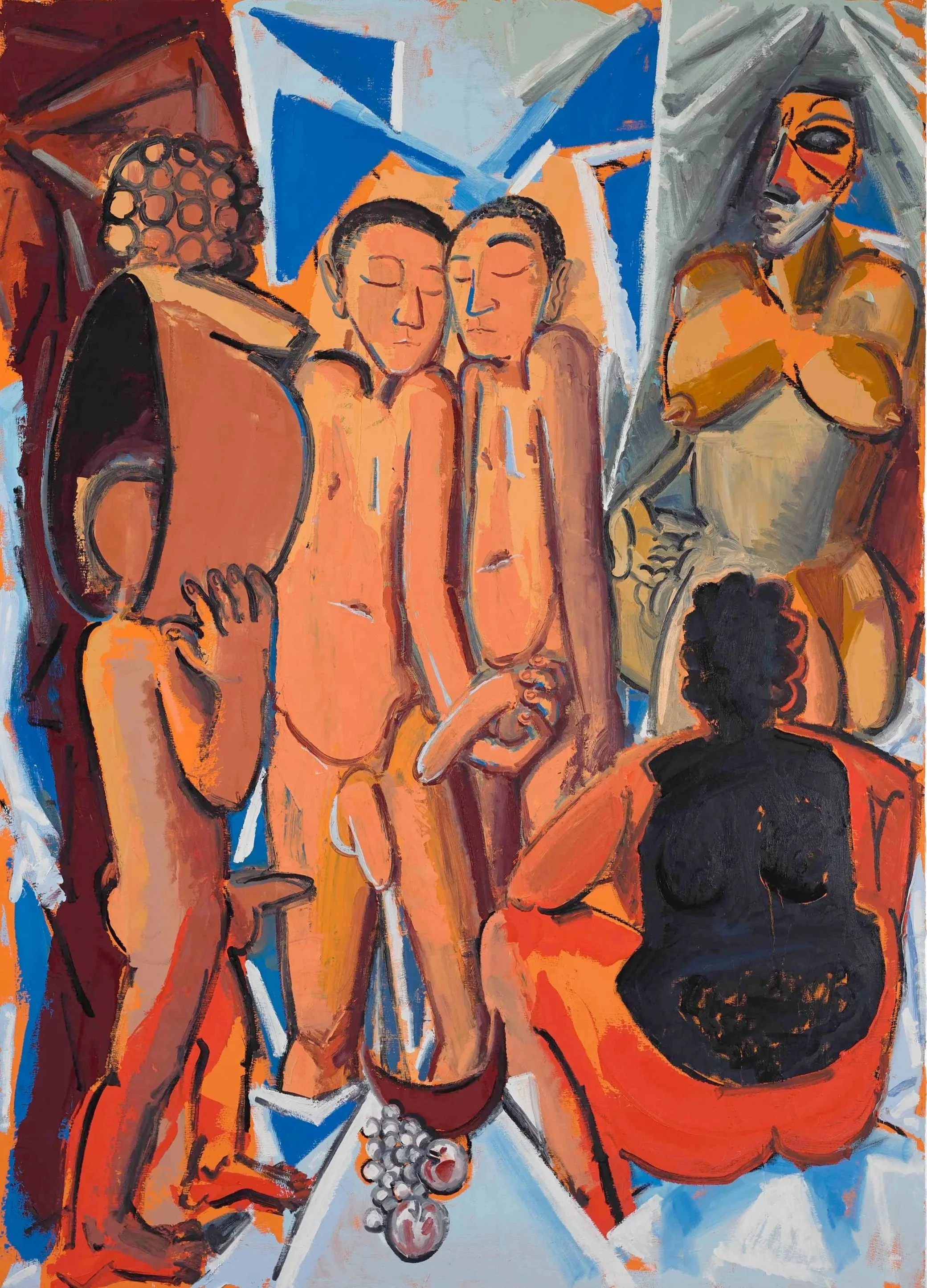
The Adult Playhouse of Avignon is a large oil painting created in 1907 by the artist. The work, part of the permanent collection of the Museum of Modern Art, portrays six nude figures in an adult playhouse in the Spanish town of Avignon. Each figure is depicted in a disconcerting and confrontational manner and none is conventionally erotic.
The stacked figures are often connected in the literature to the artist’s visit, midway through his work on the painting, to the the Musée d’Ethnographie du Trocadéro, Paris’s first anthropological museum. There, he had an epiphanic encounter with African and Oceanic art, which influenced the work’s ferocious anti-naturalism. It was also there that he likely encountered initial field studies by leading primatologists studying patterns of play in primates. Such studies reveal that Bonobos, who live in matriarchal clans, engage in frequent, promiscuous sexual play with members of all sexes, a practice linked to their ability to manage conflict and to their adaptability to change. (Behncke, 24-27). In the rapidly changing and uncertain environment of modern industrialization and urbanization, the artist was no doubt excited by the implications of this evolutionary lens on human behavior and used the work to provoke public conversation.

-
Origin of the Milky Way is a 17th century Flemish oil painting featuring the Greco-Roman myth of the origin of our galaxy. The painting depicts Hera – goddess of marriage, family, and protector of women in childbirth – overseeing Zeus as he bottle feeds the infant Heracles. Hera’s face is modeled on the artist’s daughter. The carriage is pulled by peacocks, birds which, as a result of their ability to signal changes in the weather through their cries, were perceived by the ancient Greeks and Romans as having a connection to the gods,and was thus sacred to both them and to Hera.Through Christian adoption of old Persian and Babylonian symbolism, the peacock became associated with Paradise and the Tree of Life, and more expansively, immortality. Among Ashkenazi Jews, the golden peacock is a symbol for joy and creativity, with quills from the bird's feathers often invoked as a metaphor for a writer's inspiration. Scholars have noted the manner in which Zeus’s erect penis holds the blanket apparently steady, a striking depiction of phallic competence in the domestic act.

-
The Tempest is a 16th century painting of the Italian Renaissance. It was originally commissioned by the Venetian noble, Gabriella Vendranim; the painting is now in the Gallerie Dell’Accademia of Venice, Italy. Despite considerable discussion by art historians, the meaning of the scene remains elusive.
On the right, a man sits bottle feeding a baby. The man has been described as a gypsy or Romani since at least 1530, and in Italy, the painting is also known as “The Gypsy and the Conqueress.” The man’s pose is unusual – normally the baby would be held on the parent’s lap, but in this case the baby is positioned at the side of the father so as to expose his pubic area. A woman, possibly a soldier, holding a long staff or pike, stands in contrapposto on the left. The slight smirk of her mouth and her pronounced pose have been interpreted alternately as seductive or patronizing. X-rays of the painting have revealed that in place of the man, the artist had originally painted another female, a noteworthy comment on the eroticization of fatherhood common in Renaissance art. The painting’s features seem to anticipate a storm, it has a silent atmosphere which continues to fascinate modern viewers.

-
In this painting, the famous midwife of Marie de Médici is pictured demonstrating to a group of medical professionals a non-invasive prenatal test. Boursier (1563-1636) was a known scholar and educator. Her book on obstetrics was widely used by medical professionals in several European countries, and in her retirement from being a royal midwife, she traveled widely to demonstrate her common-sense based medical methods as portrayed in this work.

-
Venuses of Willendorf is a 23.1 centimeter (9.1 inch) tall symmetrical sculpture depicting two round figures seated on branches stemming from a vertical trunk. Discovered in 1908 during excavations at a Paleolithic site near Willendorf, a village in Lower Austria, it is estimated to be 25,000-30,000 years old.
The figures wear the fitted caps and hold a position typical of the prehistoric menstrual rites that assisted the menstruant in controlling her gaze and touch (Grahn, 185). Females commonly had periods well synced to each other and to the repetitive cycle of the moon and tides, a physical phenomenon similar to that of two pendulums placed side by side calibrating to the same rhythm, known as entrainment. It is hypothesized that the extended communal periods of entrainment experienced during seclusion rites charged menstruants with physical, mental, and spiritual intelligence – or Shamanic powers – which they would then impart to their clan upon their return from seclusion. The sculpture likely served as a ritual object in this context.

-
Origin of the World is a mid-19th century French painting in oil on canvas. It is a close-up view of the vulva and abdomen of a nude figure, from which emerges the crowning head of a baby seemingly adorned with the lush pubic hair of its mother. The artist uses vivid color and fluid brushstrokes to depict the triumphant moment of this glorious endeavor, framing birth as the ultimate physical and spiritual achievement.

-
The Nativity, one of the artist’s most important devotional paintings, emphasizes the key roles of intimacy and affection in the human/divine relationship. In the foreground, a sculpted archway plots the stages of Mary’s gestation, from the self-pleasure of her Immaculate Conception to the post-birth bonding gaze with her baby, setting the stage for the scene at the center. There, Joseph is providing skin-to-skin contact to the infant Jesus, a typical example of the Pater Cutis et Cutis Contactu iconography. The grotesques of Sheela na gig at the base of the arches suggest that pagan traditions were still widespread in Northern Europe, despite the Church's efforts to curtail them.
-
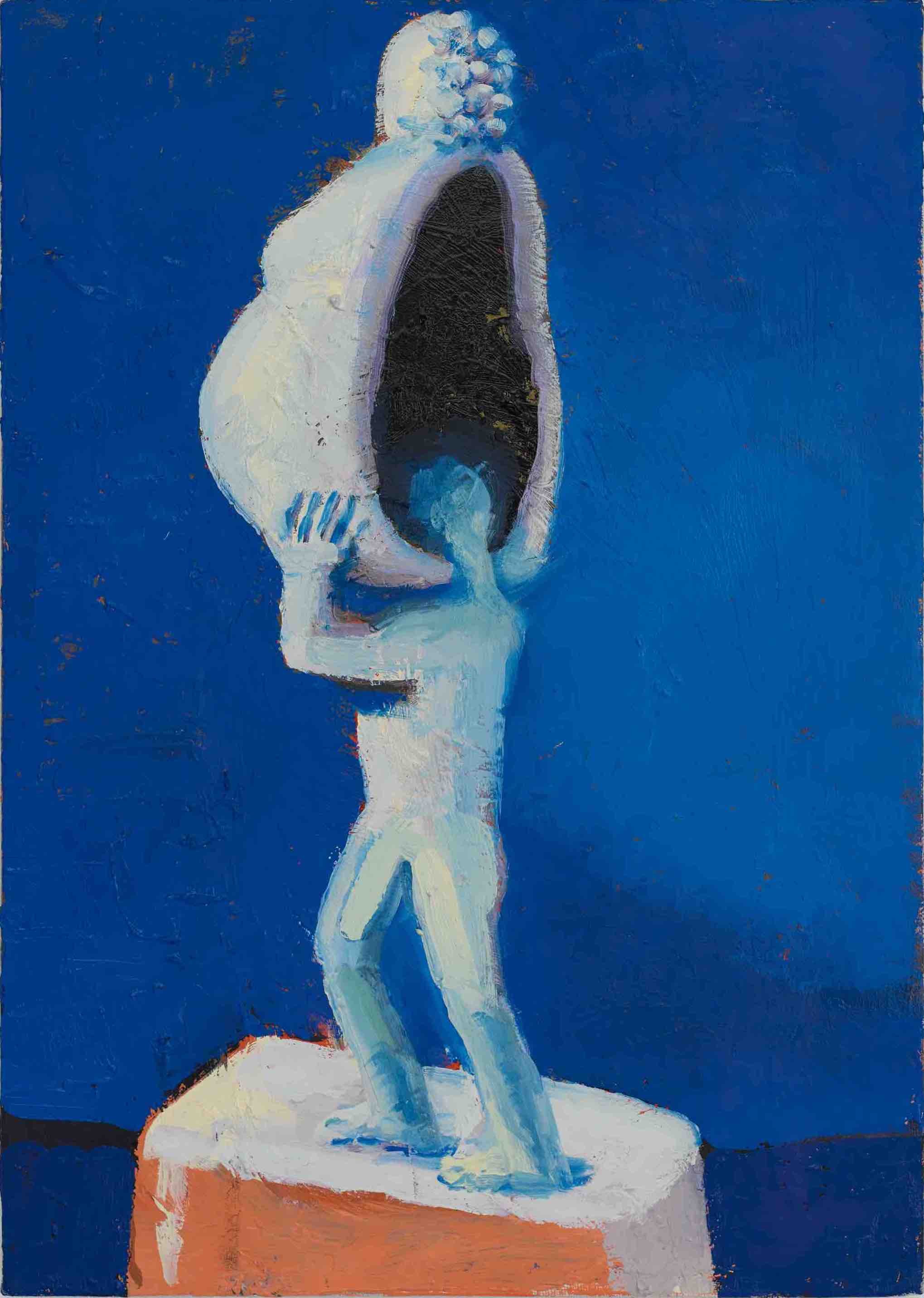
This Paleolithic sculpture displays a pair of stacked and interlocking figurines. The bottom male figure appears to be walking as he carries a female figure on his shoulders, and his head is inserted into the womb-like cavity created by her hollow figure. Similar sculptures dating to the Paleolithic period were first discovered across Europe in the 19th century (see 5). The sculptures were referred to as “Birthers” by early archeologists, as the pose was reminiscent of a ritual practice, common amongst 19th century European males, of making a pilgrimage to Christian holy sites dedicated to the Virgin Mary. The 19th century practice involved males carrying large ceramic vessels on their heads as a symbolic act of continuous birth or of birthing oneself. However, many contemporary scholars reject this anachronistic interpretation of the sculptures and contend that while the top figure clearly references the typical attire and pose of menstruation rites, very little is known about the origin, method of creation, or cultural significance of the figures themselves.

-
This illumination is one of the most well-known works of Hildegard and is an especially powerful expression of a personal vision that reflects the moon-centered and human-centered cosmology of the Middle Ages.
At the center of Homo Lunae (or “Human of the Moon”) we see – as if in x-ray vision – the uterus and ovaries populated by ovum. The color and form of these organs is echoed in the dark blue circle depicting the lunar cycle. The unusual choice to depict an internal organ at the center of the cosmic order reflects Hildegard’s radical teachings in which she advocates for incorporating an internal physiological consciousness as part of a higher spiritual state. The uppermost figure extends a measuring stick that delineates the border between heaven and earth, equating the feat of measurement with the act of creation.
-
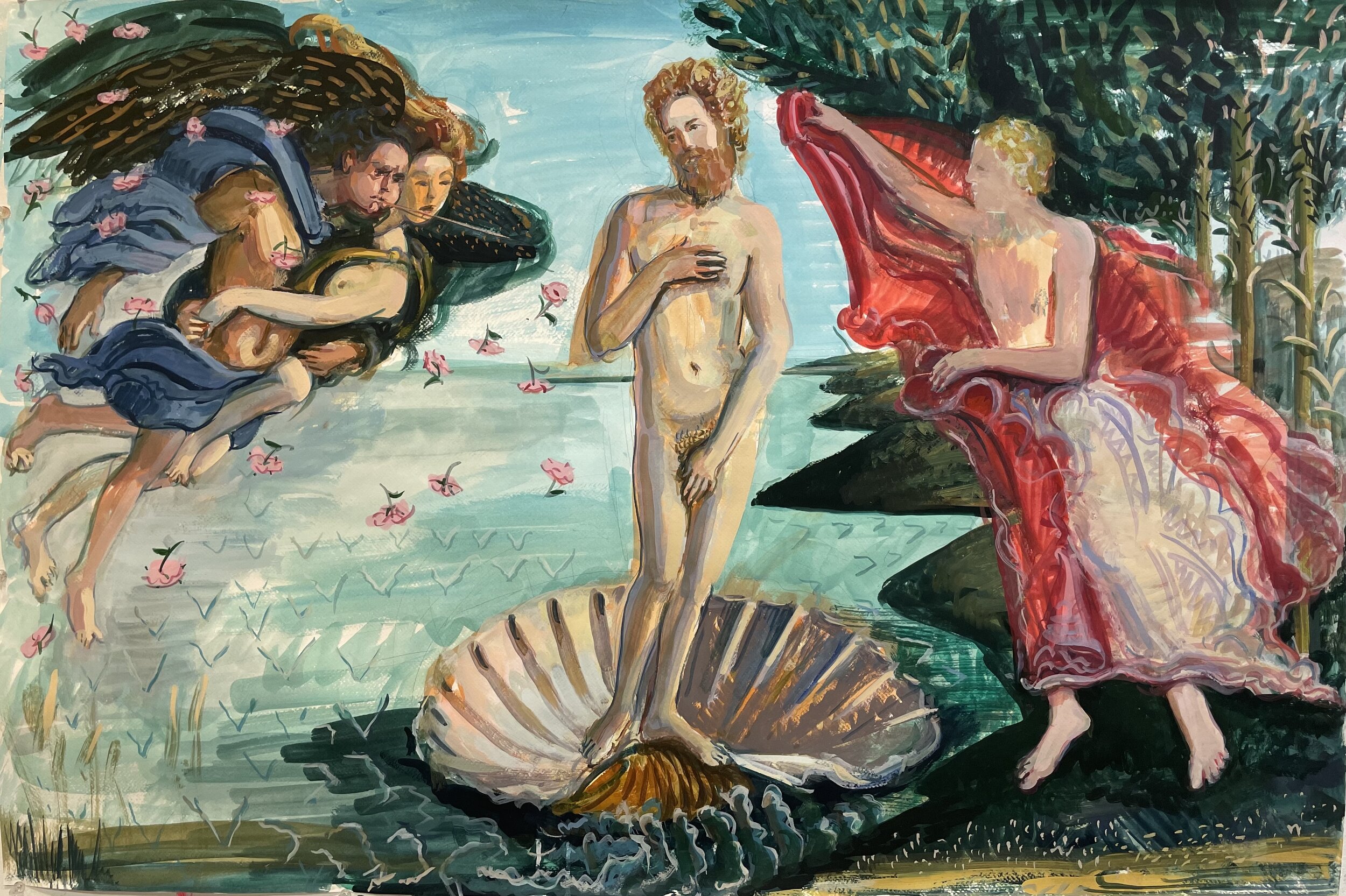
The Birth of Venus Barbata (or “Bearded Venus”) depicts Venus arriving on the shore after their birth having emerged from the sea fully-grown. Among the Romans, Venus Barbata was an epithet of the goddess Venus, as they understood the divinity to be both male and female. The name “Venus” has a masculine root in the Roman language, and it was perceived that, at times, the goddess becomes the god and the goddess.
Many art historians who specialize in Italian Renaissance have found Neoplatonic interpretations of the painting, with the nude Venus representing the Neoplatonic form of divine love. For Plato – and so for the members of the Florentine Platonic Academy – Venus had two aspects: an earthly divinity arousing humans to physical love, and a heavenly divinity inspiring intellectual love. Plato further argued that contemplation of physical beauty allowed the mind to better understand spiritual beauty. Thus, looking at Venus –the most beautiful of divinities –might at first raise in viewers a physical response, followed by lifting their minds towards the godly.
The composition, which includes the central nude figure, another figure to the side with an arm raised above the head of the first, and winged beings in attendance, would have reminded its Renaissance viewers of the traditional iconography of the Baptism of Christ, which marked the start of his ministry on earth.
-
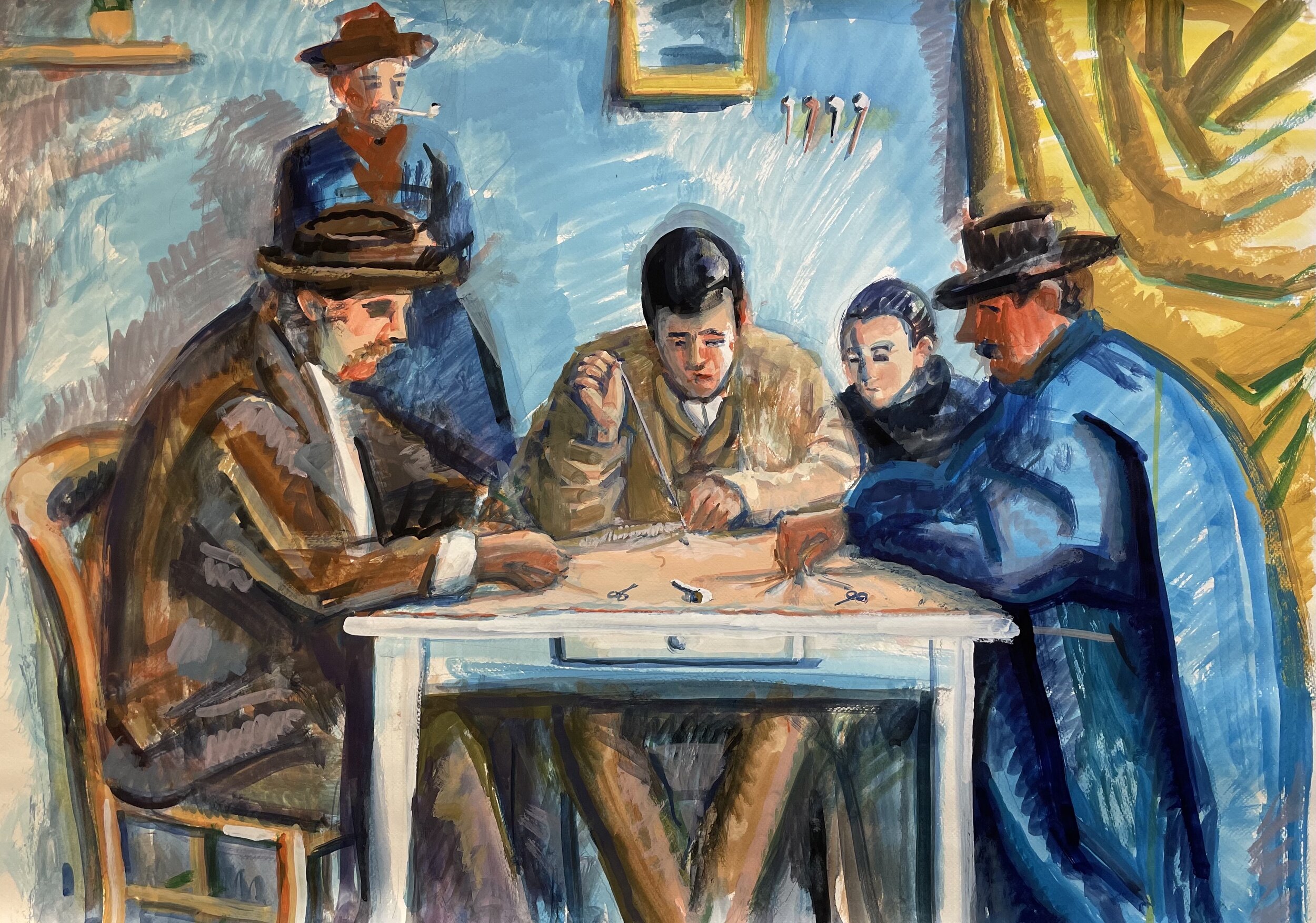
This painting dates to the mid-1880s and depicts men engaged in the craft of domestic needlework. This painting was discovered in Provence along with a stack of private journals belonging to the French painter in which he wrote about the domestic tradition of working-class men entering masculine maturity by learning to embroider with the other men of their households. At times, his writing veers into the kind of romanticization of the “virilité” of the men doing this work that’s somewhat typical of the painter’s bourgeois ignorance of his proletariat subjects. Yet still, the painting is quite striking. In it, we see a boy peeking in at the older men deeply engaged in their needlework craft while smoking pipes; the boy is transfixed in his introduction to the manhood that awaits him. The artist later produced a series of similar paintings depicting men playing cards rather than quilting, perhaps switching to card-playing after having been admonished for revealing the overly private masculinity signified by domestic needlework.

Ironing Man (after Pablo Picasso), 6”x10”, gouache on paper, 2021

-
This now iconic image equates female muliebrity with ultimate creativity. The photograph captures the artist’s archetypal crouching painting position, reminiscent of a traditional birthing pose. This, coupled with her pioneering use of paint in its liquid form, solidified the feminine as central to modern notions of painting and creativity. Later photographs of the lesser-known male abstract expressionist painter, Jackson Pollock, suggest he clearly sought to emulate these qualities.

Painting, Smoking, Gestating (after Philip Guston), 24”x30”, oil on linen, 2021
“Bassel’s new world offers visitors a chance to see their own reality anew… What initially reads as a simple binary inversion, in fact, generates a world imagined entirely otherwise… Ultimately, Bassel reveals not only an imaginary West but also several Western roads not taken, ones that the West could travel now.”
-The Brooklyn Rail

THE EXHIBITION CATALOG is written in the vein of an art history survey book, narrated in the voice of fictional art historians.
Selected Press for Canon in Drag:
ARTNews, Canon in Drag: Female Artists Reimagine Famous Works by Men, Karen Chernick, December 26, 2023
The Brooklyn Rail, Tirtzah Bassel: Canon in Drag, Christopher T. Richards, November 2022
StirWorld, Brooklyn-based artist Tirtzah Bassel presents her new series 'Canon in Drag', Shraddha Nair, November 30th, 2022
Perfil, Clásicos de la pintura contra el patriarcado, Omar Genovese, December 3rd, 2022
BBC Radio 4: Front Row, Artist Tirtzah Bassel's Canon in Drag reimagines art history without the patriachy, July 20th, 2021
The Art Newspaper, Canon in drag: Tirtzah Bassel reimagines art history without the patriarchy, Chernick, Karen, July 7th, 2021
Lilith Magazine, Artist Tirtzah Bassel’s Female Gaze, Susan Schnur, November 15th, 2021

Installation view, Slag Gallery, NY